The entire territory of modern Pakistan was occupied by the British East India Company, then the British Empire, through a series of wars, the main ones being the Battle of Miani (1843) in Sindh, the gruelling Anglo-Sikh Wars (1845–1849) and the Anglo-Afghan Wars (1839–1919), to remain a part of British Indian Empire until the freedom in 1947. The physical presence of the British was not very significant; they employed "Divide and Rule" political strategy to remain in power. In his historical survey Constantine's Sword, James P. Carroll writes: "Certainly that was the story of the British Empire's success, and its legacy of nurtured local hatreds can be seen wherever the Union Flag flew." . The administrative units of British India under the tenancy or the sovereignty of either the East India Company or the British Crown lasted between 1612 and 1947.
Saturday, 3 November 2012


Later Medieval Age History of Pakistan
Arab Invasion
Although soon after conquering the Middle East from the Byzantine empire Arab forces had reached the present western regions of Pakistan, during the period of Rashidun caliphacy, it was in 712 CE that a young Arab general called Muhammad bin Qasim conquered most of the Indus region for the Umayyad empire, to be made the "As-Sindh" province with its capital at Al-Mansurah, 72 km (45 mi) north of modern Hyderabad in Sindh. But the instability of the empire and the defeat in various wars with north Indian rulers including the Battle of Rajasthan, where the Hindu Rajput clans defeated the Umayyad Arabs, they were contained till only Sindh and southern Punjab. There was gradual conversion to Islam in the south, especially amongst the native Hindu and Buddhist majority, but in areas north of Multan, Hindus and Buddhists remained numerous. By the end of 10th century CE, the region was ruled by several Hindu Shahi kings who would be subdued by the Ghaznavids.
 |
Arab Invasion |
In 997 CE, Mahmud of Ghazni, took over the Ghaznavid dynasty empire established by his father, Sebuktegin, a Turkic origin ruler. Starting from the city of Ghazni (now in Afghanistan), Mehmood conquered the bulk of Khorasan, marched on Peshawar against the Hindu Shahis in Kabul in 1005, and followed it by the conquests of Punjab (1007), deposed the Shia Ismaili rulers of Multan, (1011), Kashmir (1015) and Qanoch (1017). By the end of his reign in 1030, Mahmud's empire extended from Kurdistan in the west to the Yamuna river in the east, and the Ghaznavid dynasty lasted until 1187. Contemporary historians such as Abolfazl Beyhaqi and Ferdowsi described extensive building work in Lahore, as well as Mahmud's support and patronage of learning, literature and the arts.
Delhi Sultanate
The sultans (emperors) of Delhi enjoyed cordial relations with rulers in the Near East but owed them no allegiance. While the sultans ruled from urban centers, their military camps and trading posts provided the nuclei for many towns that sprang up in the countryside. Close interaction with local populations led to cultural exchange and the resulting "Indo-Islamic" fusion has left a lasting imprint and legacy in South Asian architecture, music, literature, life style and religious customs. In addition, the language of Urdu (literally meaning "horde" or "camp" in various Turkic dialects) was born during the Delhi Sultanate period, as a result of the mingling of speakers of native Prakrits, Persian, Turkish and Arabic languages.
Perhaps the greatest contribution of the Sultanate was its temporary success in insulating South Asia from the Mongol invasion from Central Asia in the 13th century; nonetheless the sultans eventually lost Afghanistan and western Pakistan to the Mongols (see the Ilkhanate Dynasty). The Sultanate declined after the invasion of Emperor Timur, who founded the Timurid Dynasty, and was eventually conquered in 1526 by the Mughal king Babar.
Guru Nanak (1469–1539), was born in the village of Rāi Bhōi dī Talwandī, now called Nankana, near Sial in modern-day Pakistan into a Hindu Khatri family. He was an influential religious and social reformer of north India and the saintly founder of a modern monothiestic order and first of the ten divine Gurus of Sikh Religion. At the age of 70, he had a miraculous death in Cartarpur, Punjab of modern-day Pakistan. Sikhism was created and would continue to grow; its followers, the Sikhs, would politicalise and militarise to play a historic role later.
Mughal Empire
Akbar the Great, was both a capable ruler and an early proponent of religious and ethnic tolerance and favored an early form of multiculturalism. He declared "Amari" or non-killing of animals in the holy days of Jainism and rolled back the jizya tax imposed upon non-Islamic mainly Hindu people. The Mughal dynasty ruled most of the Indian subcontinent by 1600. The Mughal emperors married local royalty and allied themselves with local maharajas. For a short time in the late 16th century, Lahore was the capital of the empire. The architectural legacy of the Mughals in Lahore includes the Shalimar Gardens built by the fifth Emperor Shahjahan, and the Badshahi Mosque built by the sixth Emperor, Aurangzeb, who is regarded as the last Great Mughal Emperor as he expanded the domain to its zenith. After his demise, different regions of modern Pakistan began asserting independence. The empire went into a slow decline after 1707 and its last sovereign, ruling around Delhi region.
 |
Mughal Empire |
Post Mughal era
Durrani Empire
In 1739, Nader Shah, the Turkic emperor of Afsharid dynasty in Persia, invaded South Asia, defeated the Mughal Emperor Mohammed Shah at the huge Battle of Karnal, and occupied most of Balochistan and the Indus plain. After Nadir Shah's death, the Durrani kingdom was established in 1747 by one of his Afghan generals, Ahmad Shah Abdali, and included Balochistan, Peshawar, Daman, Multan, Sind and Punjab. In the south, a succession of autonomous dynasties (the Daudpotas, Kalhoras and Talpurs)
had asserted the independence of Sind, from the end of Aurangzeb's
reign. Most of Balochistan came under the influence of the Khan of Kalat, apart from some coastal areas such as Gwadar, which were controlled by mutually competing and armed Portuguese, French and Dutch trading companies.
Maratha Empire
In 1758 the Maratha Empire's general Raghunath Rao marched onwards, attacked and conquered Punjab, Khyber Pakhtunkhwa and Kashmir and drove out Timur Shah Durrani, the son and viceroy of Ahmad Shah Abdali. Lahore, Dera Ghazi Khan, Multan, Peshawar, Kashmir and other subahs on the south eastern side of Afghanistan's border were under the Maratha rule for the most part. In Punjab, Nwfp and Kashmir, the Marathas were now major players.
.jpg) |
Maratha Empire |
Durrani reconquest
In 1761, following the victory at the Third battle of Panipat between the Durrani and the Maratha Empire, Ahmad Shah Abdali captured remnants of the Maratha Empire in Punjab and Kashmir regions and had re-consolidated control over them.
Sikh Empire
The Sikh Empire (1799–1849) was formed on the foundations of the Punjabi Army by Maharaja Ranjit Singh who was proclaimed "Sarkar-i-Khalsa", and was referred to as the "Maharaja of Lahore". It consisted of a collection of autonomous Punjabi Misls, which were governed by Misldars, mainly in the Punjab region. The empire extended from the Khyber Pass in the west, to Kashmir in the north, to Multan in the south and Kapurthala in the east. The main geographical footprint of the empire was the Punjab region. The formation of the empire was a watershed and represented the resurgence of the local culture and power which had been subdued for hundreds of years by Afghan and Mughal rule.
The foundations of the Sikh Empire, during the time of the Punjabi Army, could be defined as early as 1707, starting from the death of Aurangzeb. The fall of the Mughal Empire provided opportunities for the Punjabi army to lead expeditions against the Mughals and Pashtuns. This led to a growth of the army, which was split into different Punjabi armies and then semi-independent "misls". Each of these component armies were known as a misl, each controlling different areas and cities. However, in the period from 1762–1799, Sikh rulers of their misls appeared to be coming into their own. The formal start of the Sikh Empire began with the disbandment of the Punjab Army by the time of coronation of Ranjit Singh in 1801, creating a unified political state. All the misl leaders who were affiliated with the Army were nobility with usually long and prestigious family histories in Punjab's history.
 |
| Maharaja Ranjit Singh, born in Gujranwala, Punjab. He was referred to as the "Maharaja of Lahore". |
Thursday, 1 November 2012
Early history of Pakistan
Vedic period
Early Vedic society consisted of largely pastoral groups, with late Harappan urbanization having been abandoned. After the time of the Rigveda, Aryan society became increasingly agricultural and was socially organized around the four varnas, or social classes. In addition to the Vedas, the principal texts of Hinduism, the core themes of the Sanskrit epics Ramayana and Mahabharata are said to have their ultimate origins during this period. The early Indo-Aryan presence probably corresponds, in part, to the Ochre Coloured Pottery culture in archaeological contexts.
The Kuru kingdom corresponds to the Black and Red Ware and Painted Grey Ware cultures and to the beginning of the Iron Age in South Asia, around 1000 BCE, as well as with the composition of the Atharvaveda, the first Vedic text to mention iron, as śyāma ayas, literally "black metal." The Painted Grey Ware culture spanned much of northern India from about 1100 to 600 BCE. The Vedic Period also established republics such as Vaishali, which existed as early as the 6th century BCE and persisted in some areas until the 4th century CE. The later part of this period corresponds with an increasing movement away from the previous tribal system towards the establishment of kingdoms, called mahajanapadas.
 |
Vedic period |
Achaemenid Empire
Gandhara and Sattagydia (Thatagus) are listed amongst the provinces inherited by Darius when he seized the throne in 522 BC in his commemorative Behistun inscription, however, the dates of the initial annexation of these two regions is not certain. The locations of Sattagydia and Hindush and the extent of their boundaries have not been identified either though it is certain that these two tributaries existed along the river Indus as the name Hindush is analogous with the Indus and was derived by the Persians from the Sanskrit word Sindhu.
Additionally, much of what constitutes Balochistan province in southwest Pakistan formed part of the Achaemenid satrap of Gedrosia.
 |
Achaemenid Empire |
Greek invasion
 |
Greek invasion |
Maurya Empire
Modern day Pakistan was conquered by Chandragupta Maurya, who overthrew the powerful Nanda Dynasty of Magadha and established Maurya empire: He conquered the trans-Indus region to the west, which was under Macedonian rule - annexing Balochistan, south eastern parts of Iran and much of what is now Afghanistan, including the modern Herat and Kandahar provinces - and then defeated the invasion led by Seleucus I, a Greek general from Alexander's army. Seleucus is said to have reach a peace treaty with Chandragupta by giving control of the territory south of the Hindu Kush to him upon intermarriage and 500 elephants.
The Empire was expanded into India's central and southern regions by the emperors Chandragupta and Bindusara, but it excluded a small portion of unexplored tribal and forested regions near Kalinga (modern Orissa), till it was conquered by Ashoka. With an area of 5,000,000 km2, it was one of the world's largest empires in its time, and the largest ever in the Indian subcontinent. At its greatest extent, the empire stretched to the north along the natural boundaries of the Himalayas, and to the east stretching into what is now Assam province near the border with modern Myanmar (Burma).Alexander took these away from the Indo-Aryans and established settlements of his own, but Seleucus Nicator gave them to Sandrocottus (Chandragupta), upon terms of intermarriage and of receiving in exchange 500 elephants.—Strabo, 64 BC–24 AD
Under Chandragupta and his successors, internal and external trade, agriculture and economic activities, all thrived and expanded across India thanks to the creation of a single and efficient system of finance, administration, and security. Mauryan India also enjoyed an era of social harmony, religious transformation, and expansion of the sciences and of knowledge. Mauryans were followers of Buddhism and Hinduism. Chandragupta Maurya's embrace of Jainism increased social and religious renewal and reform across his society, while Ashoka's embrace of Buddhism has been said to have been the foundation of the reign of social and political peace and non-violence across all of South Asia. Ashoka sponsored the spreading of Buddhist ideals into Sri Lanka, Southeast Asia, West Asia and Mediterranean Europe. After the Kalinga War, the Empire experienced half a century of peace and security under Ashoka. Mauryan Empire's decline began 60 years after Ashoka's rule ended, and it dissolved in 185 BC with the foundation of the Sunga Dynasty in Magadha.
 |
Maurya Empire |
Gandhara culture
Greco-Buddhism (or Græco-Buddhism) was the syncretism between the culture of Classical Greece and Buddhism in the then Gandhara region of modern Afghanistan and Pakistan, between the 4th century BCE and the 5th century CE. It influenced the artistic development of Buddhism, and in particular Mahayana Buddhism, before it spread to central and eastern Asia, from the 1st century CE onward. Demetrius (son of the Greco-Bactrian king Euthydemus) invaded northern India in 180 BCE as far as Pataliputra and established an Indo-Greek kingdom. To the south, the Greeks captured Sindh and nearby coastal areas, completing the invasion by 175 BCE and confining the borders of Sunga's (Magadha Empire) to the east. Meanwhile, in Bactria, the usurper Eucratides
killed Demetrius in a battle. Although the Indo-Greeks lost part of the
Gangetic plain, their kingdom lasted nearly two centuries.
Graeco-Indians
The Indo-Greek Menander I (reigned 155–130 BCE) drove the Greco-Bactrians out of Gandhara and beyond the Hindu Kush, becoming a king shortly after his victory. His territories covered Panjshir and Kapisa in modern Afghanistan and extended to the Punjab region, with many tributaries to the south and east, possibly as far as Mathura. The capital Sagala (modern Sialkot) prospered greatly under Menander's rule and Menander is one of the few Bactrian kings mentioned by Greek authors. The classical Buddhist text Milinda Pañha praises Menander, saying there was "none equal to Milinda in all India". His empire survived him in a fragmented manner until the last independent Greek king, Strato II, disappeared around 10 CE. Around 125 BCE, the Greco-Bactrian king Heliocles, son of Eucratides, fled from the Yuezhi invasion of Bactria and relocated to Gandhara, pushing the Indo-Greeks east of the Jhelum River. The last known Indo-Greek ruler was Theodamas, from the Bajaur area of Gandhara, mentioned on a 1st century CE signet ring, bearing the Kharoṣṭhī inscription "Su Theodamasa" ("Su" was the Greek transliteration of the Kushan royal title "Shau" ("Shah" or "King")). Various petty kings ruled into the early 1st century CE, until the conquests by the Scythians, Parthians and the Yuezhi, who founded the Kushan dynasty.
 |
Graeco-Indians |
Indo-Scythians
The Indo-Scythians were descended from the Sakas (Scythians) who migrated from southern Siberia to pakistan and Arachosia
from the middle of the 2nd century BCE to the 1st century BCE. They
displaced the Indo-Greeks and ruled a kingdom that stretched from
Gandhara to Mathura. Scythian tribes spread into the present-day Pakistan region and the Iranian plateau.
 |
Indo-Scythians |
Indo-Parthians, Romans and Christianity
The Parni, a nomadic Central Asian tribe, invaded Parthia
in the middle of the 3rd century BCE, drove away its Greek satraps —
who had just then proclaimed independence from the Seleucids — and
annexed much of the Indus region, thus founding an Arsacids dynasty of Scythian or Bactrian origin. Following the decline of the central Parthian authority after clashes with the Roman Empire, a local Parthian leader, Gondophares established the Indo-Parthian Kingdom in the 1st century CE. The kingdom was ruled from Taxila and covered much of modern southeast Afghanistan and Pakistan. Christian writings claim that the Apostle Saint Thomas – an architect and skilled carpenter – had a long sojourn in the court of king Gondophares, had built a palace for the king at Taxila and had also ordained leaders for the Church before leaving for Indus Valley in a chariot, for sailing out to eventually reach Malabar Coast.
Kushan Empire
The Kushan kingdom was founded by King Heraios, and greatly expanded by his successor, Kujula Kadphises. Kadphises' son, Vima Takto conquered territory now in India, but lost much of the west of the kingdom to the Parthians. The fourth Kushan emperor, Kanishka I, (c. 127 CE) had a winter capital at Purushapura (Peshawar) and a summer capital at Kapisa (Bagram). The kingdom linked the Indian Ocean maritime trade with the commerce of the Silk Road through the Indus valley. At its height, the empire extended from the Aral Sea to northern India, encouraging long-distance trade, particularly between China and Rome. Kanishka convened a great Buddhist council in Taxila, marking the start of the pantheistic Mahayana Buddhism and its scission with Nikaya Buddhism.
The art and culture of Gandhara — the best known expressions of the
interaction of Greek and Buddhist cultures — also continued over several
centuries, until the 5th century CE White Hun invasions of Scythia. The travelogues of Chinese pilgrims Fa Xian (337 – ca.422 CE) and Huen Tsang (602/603–664 CE) describe the state of famed Buddhist seminary at Taxila and the status of Buddhism in the region of Pakistan in this period.
Gupta Empire
The Gupta Empire existed approximately from 320 to 600 CE and covered much of the Indian Subcontinent, including Pakistan. Founded by Maharaja Sri-Gupta, the dynasty was the model of a classical civilization and was marked by extensive inventions and discoveries.
The high points of this cultural creativity are magnificent architectures, sculptures and paintings. Science and political administration reached new heights during the Gupta era. Strong trade ties also made the region an important cultural center and set the region up as a base that would influence nearby kingdoms and regions in Burma, Sri Lanka, Maritime Southeast Asia and Indochina.
The empire gradually declined due in part to loss of territory and imperial authority caused by their own erstwhile feudatories, and from the invasion by the Hunas from Central Asia. After the collapse of the Gupta Empire in the 6th century, India was again ruled by numerous regional kingdoms. A minor line of the Gupta clan continued to rule Magadha after the disintegration of the empire. These Guptas were ultimately ousted by the Vardhana king Harsha, who established an empire in the first half of the 7th century.
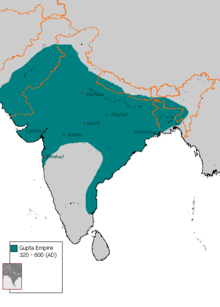 |
Gupta Empire |
Sassanid Empire
Over the next few centuries, while the Parthians and Kushans shared
control of the Indus plain until the arrival of the White Huns, the
Persian Sassanid Empire dominated the south and southwest. The revival of Persian cultures in the region gave rise to the Sassanid culture, which initially flourished in Balochistan and Western Punjab, but later spread to all of Pakistan.
The White Huns
The White Huns, who seem to have been part of the predominantly Buddhist Hephthalite group, established themselves in Afghanistan by the first half of the 5th century, with their capital at Bamiyan. Led by the Hun military leader Toramana, they overran the northern region of Pakistan and made their capital at the city of Sakala, modern Sialkot in Pakistan, under Toramana's son, Emperor Mihirakula, who was a Saivite Hindu. Hiuen Tsiang narrates Mihirakula's merciless persecution of Buddhists and destruction of monasteries.
Rai dynasty
According to Arab chroniclers, the Rai Dynasty of Sindh (c. 489–632) arose after the end of Ror Dynasty. They were practitioners of Hinduism and Buddhism; they established a huge temple of Shiva in present-day Sukkur – derived from original Shankar – close to their capital in Al-ror. At the time of Rai Diwaji (Devaditya), influence of the Rai-state exdended from Kashmir in the east, Makran and Debal (Karachi) port in the south, Kandahar, Sistan, Suleyman, Ferdan and Kikanan hills in the north.
Harsha, Rajputs and Pāla Empire
The Pāla's were a Buddhist dynasty of Bengal, which lasted for four centuries (750–1120 AD). The empire reached its peak under Dharmapala and Devapala to cover much of South Asia and beyond up to Kamboja (modern day Afghanistan), shattering the pride of many a ruler, including the Huna. Followers of the Mahayana and Tantric schools of Buddhism, they were responsible for the introduction of Mahayana Buddhism in Nepal, Bhutan, Tibet, Myanmar and the Malay archipelago, creation of temples and works of art and patronage of great universities formerly patronized by Emperor Harsha Vardhana. The Palas had extensive trade as well as influence in South-east Asia. The Pala Empire eventually disintegrated in the 12th century under the attack of the Hindu Sena dynasty.
.gif) |
Harsha, Rajputs and Pāla Empire |
 |
Harsha, Rajputs and Pāla Empire |
Prehistory of Pakistan
Soanian Culture
The Soanian is an archaeological culture of the Lower Paleolithic (ca. 1.9 mya to 125,000 BC), contemporary to the Acheulean. It is named after the Soan Valley in the Sivalik Hills, near modern-day Islamabad/Rawalpindi, Pakistan. The bearers of this culture were Homo erectus. In Adiyala and Khasala, about 16 kilometres (9.9 mi) from Rawalpindi, on the bend of the Soan River
hundreds of edged pebble tools were discovered. No human skeletons of
this age have yet been found. In the Soan River Gorge many fossil
bearing rocks are exposed on the surface. The 14 million year old
fossils of gazelle, rhinoceros, crocodile, giraffe and rodents have been
found there. Some of these fossils are on display at the Natural
History Museum in Islamabad.
 |
Soanian Culture |
Mehrgarh
Mehrgarh, (7000–5500 BCE), on the Kachi Plain of Balochistan, is an important Neolithic site discovered in 1974, with early evidence of farming and herding, and dentistry. Early residents lived in mud brick houses, stored grain in granaries, fashioned tools with copper ore, cultivated barley, wheat, jujubes and dates, and herded sheep, goats and cattle. As the civilization progressed (5500–2600 BCE) residents began to engage in crafts, including flint knapping, tanning, bead production, and metalworking. The site was occupied continuously until 2600 BCE, when climatic changes began to occur. Between 2600 and 2000 BCE, region became more arid and Mehrgarh was abandoned in favour of the Indus Valley, where a new civilization was in the early stages of development.
Indus Valley Civilization
The Indus Valley Civilization developed between 3300–1700 BCE on the banks of the Indus River. At its peak, the civilisation hosted a population of approximately 5 million in hundreds of settlements extending as far as the Arabian Sea, present-day southern and eastern Afghanistan, southeastern Iran and the Himalayas. Major urban centers were at Dholavira, Kalibangan, Harappa, Lothal, Mohenjo-daro, and Rakhigarhi, as well as an offshoot called the Kulli culture (2500–2000 BCE) in southern Balochistan, which had similar settlements, pottery and other artifacts. The civilization collapsed abruptly around 1700 BCE.
In the early part of the second millennium BCE, the Rigvedic civilization existed, between the Sapta Sindhu and Ganges-Yamuna rivers. The city of Taxila in northern Pakistan, became important to Vedic religion (and later in Buddhism).
History of Pakistan
The first known inhabitants of the modern-day Pakistan region are believed to have been the Soanian (Homo erectus), who settled in the Soan Valley and Riwat 1.9 million years ago. Over the next several thousand years, the region would develop into various civilizations like Mehrgarh and the Indus Valley Civilization.
Prior to the independence as a modern state in 1947, the country was
both independent and under various colonial empires throughout different
time periods. The region's ancient history also includes some of the
oldest empires from the subcontinent and some of its major civilizations.
Thus, Pakistan is in fact a multi-regional state and not a South Asian
state actor only; its history if analyzed in depth would prove the
point. By the 18th century the land was incorporated into British India. The political history of the nation began with the birth of the All India Muslim League in 1906 to protect Muslim interests, amid neglect and under-representation, in case the British Raj decided to grant local self-rule. On 29 December 1930, Sir Muhammad Iqbal called for an autonomous state in "northwestern India for Indian Muslims". The League rose to popularity in the late 1930s. Muhammad Ali Jinnah espoused the Two Nation Theory and led the League to adopt the Lahore Resolution of 1940, demanding the formation of independent states in the East and the West of British India. Eventually, a united Pakistan with its wings – West Pakistan and East Pakistan – gained independence from the British, on 14 August 1947. After a civil war, the Bengal region of East Pakistan, separated at a considerable distance from the rest of Pakistan, became the independent state of Bangladesh in 1971.
Pakistan declared itself an Islamic republic on adoption of a constitution in 1956, but the civilian rule was stalled by the 1958 military coup d'etat by Ayub Khan, who ruled during a period of internal instability and a second war with India in 1965. Economic grievances and political disenfranchisement in East Pakistan led to violent political tensions and army repression, escalating into civil war followed by the third war with India. Pakistan's defeat in the war ultimately led to the secession of East Pakistan and the birth of Bangladesh.
Civilian rule resumed from 1972 to 1977 under Zulfikar Ali Bhutto, until he was deposed by General Zia-ul-Haq, who became the country's third military president. Pakistan's Obsolete-secular policies were replaced by the new Islamic Shariah legal code, which increased religious influences on the civil service and the military. With the death of Zia-ul-Haq in 1988, Benazir Bhutto, daughter of Zulfikar Ali Bhutto, was elected as the first female Prime Minister of Pakistan. Over the next decade, she alternated power with Nawaz Sharif, as the country's political and economic situation worsened. Military tensions in the Kargil conflict with India were followed by a 1999 coup d'état in which General Pervez Musharraf assumed executive powers.
In 2001, Musharraf named himself President after the resignation of Rafiq Tarar. In the 2002 Parliamentary Elections, Musharraf transferred executive powers to newly elected Prime Minister Zafarullah Khan Jamali, who was succeeded in the 2004 by Shaukat Aziz. On 15 November 2007 the National Assembly completed its term and a caretaker government was appointed with the former Chairman of The Senate, Muhammad Mian Soomro as Prime Minister. Following the assassination of Benazir Bhutto, that resulted in a series of important political developments, her husband Asif Ali Zardari was eventually elected as the new President in 2008.
Pakistan declared itself an Islamic republic on adoption of a constitution in 1956, but the civilian rule was stalled by the 1958 military coup d'etat by Ayub Khan, who ruled during a period of internal instability and a second war with India in 1965. Economic grievances and political disenfranchisement in East Pakistan led to violent political tensions and army repression, escalating into civil war followed by the third war with India. Pakistan's defeat in the war ultimately led to the secession of East Pakistan and the birth of Bangladesh.
Civilian rule resumed from 1972 to 1977 under Zulfikar Ali Bhutto, until he was deposed by General Zia-ul-Haq, who became the country's third military president. Pakistan's Obsolete-secular policies were replaced by the new Islamic Shariah legal code, which increased religious influences on the civil service and the military. With the death of Zia-ul-Haq in 1988, Benazir Bhutto, daughter of Zulfikar Ali Bhutto, was elected as the first female Prime Minister of Pakistan. Over the next decade, she alternated power with Nawaz Sharif, as the country's political and economic situation worsened. Military tensions in the Kargil conflict with India were followed by a 1999 coup d'état in which General Pervez Musharraf assumed executive powers.
In 2001, Musharraf named himself President after the resignation of Rafiq Tarar. In the 2002 Parliamentary Elections, Musharraf transferred executive powers to newly elected Prime Minister Zafarullah Khan Jamali, who was succeeded in the 2004 by Shaukat Aziz. On 15 November 2007 the National Assembly completed its term and a caretaker government was appointed with the former Chairman of The Senate, Muhammad Mian Soomro as Prime Minister. Following the assassination of Benazir Bhutto, that resulted in a series of important political developments, her husband Asif Ali Zardari was eventually elected as the new President in 2008.
 |
| History of Pakistan |
National symbols of Pakistan
Pakistan has several official national symbols
including a historic document, a flag, an emblem, an anthem, a memorial
tower as well as several national heroes. The symbols were adopted at
various stages in the existence of Pakistan and there are various rules
and regulations governing their definition or use. The oldest symbol is
the Lahore Resolution, adopted by the All India Muslim League on 23 March 1940, and which presented the official demand for the creation of a separate country for the Muslims of India.
The Minar-e-Pakistan memorial tower which was built in 1968 on the site
where the Lahore Resolution was passed. The national flag was adopted
just before independence was achieved on 14 August 1947. The national
anthem and the state emblem were each adopted in 1954. There are also
several other symbols including the national animal, bird, flower and
tree.
The Minar-e-Pakistan (Urdu: مينارِ پاكستان; Mīnār-ĕ Pākistān) or Tower of Pakistan is a 60 metre tall concrete minaret in Iqbal Park in Lahore. The Minar was built on the site where the Muslim League passed the Lahore Resolution, demanding the creation of Pakistan. Pakistan now celebrates this day as a national holiday each year under the name of Pakistan Day which is also the day in 1956 when the country became the first Islamic Republic in the world. It was designed by Muhammad Wali Ullah Khan and built by Mian Abdul Khaliq Company. The base of the tower is raised about 4 metres from the ground. The next 13 metres form a sculpted, flower-like base and from this point the Minar tapers as it rises. The base platform is shaped like a five-pointed star and it encloses crescent shaped pools. It is constructed of reinforced concrete, with the floors and walls rendered in stone and marble.
The national anthem of Pakistan or Qaumī Tarāna (Urdu: قومى ترانہ), is played during any event involving the hoisting of the flag, for example Republic Day (March 23) and Independence Day (August 14). The Constituent Assembly had not adopted a national anthem by the time Pakistan became independent, so when the flag was hoisted at the independence ceremony it was accompanied by the song, "Pakistan Zindabad, Azadi Paendabad". Muhammad Ali Jinnah asked a Lahore-based Hindu writer, Jagan Nath Azad, to write a national anthem for Pakistan. Jinnah may have done this to promote a more secular idealism for Pakistan. The anthem written by Azad was quickly approved by Jinnah, and it was played on Radio Pakistan. Azad's work remained as Pakistan’s national anthem for about eighteen months.
A National Anthem Committee was formed in 1948, but it had difficulty finding suitable music and lyrics. The impending state visit of the Shah of Iran in 1950, resulted in the hasty adoption of a three stanza composition by Ahmed Ghulamali Chagla. Initially it was performed without lyrics for the Prime Minister Liaquat Ali Khan on August 10, 1950 and was approved for playing during the visit of the Shah. However, the anthem was not officially adopted until August 1954. The National Anthem Committee eventually approved lyrics written by Abu-Al-Asar Hafeez Jullandhuri and the new national anthem was first played properly on Radio Pakistan on August 13, 1954. Official approval was announced by the Ministry of Information and Broadcasting on August 16, 1954 followed by a performance of the national anthem in 1955 involving eleven major singers of Pakistan including Ahmad Rushdi.
 |
| National symbols of Pakistan |
Lahore Resolution and Minar-e-Pakistan
Main articles: Lahore Resolution and Minar-e-Pakistan
The Lahore Resolution (Qarardad-e-Lahore (Urdu: قرارداد لاھور)), also known as the Pakistan Resolution, was a formal political statement adopted by the All India Muslim League at the occasion of its three-day general session on 22–24 March 1940 at Minto Park (now Iqbal Park),
Lahore. The resolution called for greater Muslim autonomy in British
India and has been largely interpreted as a demand for a separate Muslim
state. The idea of separate state for Indian Muslims was first suggested by Muhammad Iqbal in 1930 and the name of Pakistan was proposed by Choudhary Rahmat Ali in his Pakistan Declaration pamphlet in 1933.
Initially, Muhammad Ali Jinnah and other leaders were in favour of
Hindu-Muslim unity, but the volatile political climate and religious
hostilities of the 1930s made the idea more appealing. In his speech, Jinnah criticised the Indian National Congress and the nationalist Muslims, and espoused the Two-Nation Theory and the reasons for the demand for separate Muslim homelands. Sikandar Hayat Khan, the Chief Minister of the Punjab, drafted the original resolution, but disavowed the final version,
which followed endless redrafting by the Subject Committee of the
Muslim League. The text unambiguously rejected the concept of a "United
India" because of increasing inter-communal violence and recommended the creation of an independent Muslim state. The resolution was moved in the general session by A.K. Fazlul Huq, Chief Minister of Bengal
and was supported seconded by several leaders. The principle text of
the Lahore Resolution was passed on 24 March 1940. In 1941 it became
part of the Muslim League's constitution. By 1946, it formed the basis
for the struggle of the Muslim League for a separate Muslim state. The statement declared: |
Lahore Resolution and Minar-e-Pakistan |
No constitutional plan would be workable or acceptable to the Muslims
unless geographical contiguous units are demarcated into regions which
should be so constituted with such territorial readjustments as may be
necessary. That the areas in which the Muslims are numerically in
majority as in the North-Western and Eastern zones of India should be
grouped to constitute independent states in which the constituent units
shall be autonomous and sovereign … That adequate, effective and
mandatory safeguards shall be specifically provided in the constitution
for minorities in the units and in the regions for the protection of
their religious, cultural, economic, political, administrative and other
rights of the minorities, with their consultation. Arrangements thus
should be made for the security of Muslims where they were in a
minority.
 |
| Minar-e-Pakistan |
The Minar-e-Pakistan (Urdu: مينارِ پاكستان; Mīnār-ĕ Pākistān) or Tower of Pakistan is a 60 metre tall concrete minaret in Iqbal Park in Lahore. The Minar was built on the site where the Muslim League passed the Lahore Resolution, demanding the creation of Pakistan. Pakistan now celebrates this day as a national holiday each year under the name of Pakistan Day which is also the day in 1956 when the country became the first Islamic Republic in the world. It was designed by Muhammad Wali Ullah Khan and built by Mian Abdul Khaliq Company. The base of the tower is raised about 4 metres from the ground. The next 13 metres form a sculpted, flower-like base and from this point the Minar tapers as it rises. The base platform is shaped like a five-pointed star and it encloses crescent shaped pools. It is constructed of reinforced concrete, with the floors and walls rendered in stone and marble.
National Flag
The national flag was designed by Syed Ameer uddin kidwai and was based on the original flag of the Muslim League. It was adopted by the Constituent Assembly on August 11, 1947, just days before independence. The flag is referred to in the national anthem as Parcham-e-Sitāra-o-Hilāl in Urdu (lit. Flag of the Crescent and Star). The flag comprises a dark green field, representing the Muslim majority of Pakistan, with a vertical white stripe in the hoist, representing religious minorities. In the centre is a white crescent moon, representing progress, and a white five-pointed star, representing light and knowledge. The flag symbolizes Pakistan's commitment to Islam, the Islamic world and the rights of religious minorities. The flag is flown on several important days of the year including Republic Day and Independence Day. The flag is also flown on the residences and motor vehicles of many public officials including the President and the Prime Minister.
 |
| National Flag |
National Anthem
The national anthem of Pakistan or Qaumī Tarāna (Urdu: قومى ترانہ), is played during any event involving the hoisting of the flag, for example Republic Day (March 23) and Independence Day (August 14). The Constituent Assembly had not adopted a national anthem by the time Pakistan became independent, so when the flag was hoisted at the independence ceremony it was accompanied by the song, "Pakistan Zindabad, Azadi Paendabad". Muhammad Ali Jinnah asked a Lahore-based Hindu writer, Jagan Nath Azad, to write a national anthem for Pakistan. Jinnah may have done this to promote a more secular idealism for Pakistan. The anthem written by Azad was quickly approved by Jinnah, and it was played on Radio Pakistan. Azad's work remained as Pakistan’s national anthem for about eighteen months.
A National Anthem Committee was formed in 1948, but it had difficulty finding suitable music and lyrics. The impending state visit of the Shah of Iran in 1950, resulted in the hasty adoption of a three stanza composition by Ahmed Ghulamali Chagla. Initially it was performed without lyrics for the Prime Minister Liaquat Ali Khan on August 10, 1950 and was approved for playing during the visit of the Shah. However, the anthem was not officially adopted until August 1954. The National Anthem Committee eventually approved lyrics written by Abu-Al-Asar Hafeez Jullandhuri and the new national anthem was first played properly on Radio Pakistan on August 13, 1954. Official approval was announced by the Ministry of Information and Broadcasting on August 16, 1954 followed by a performance of the national anthem in 1955 involving eleven major singers of Pakistan including Ahmad Rushdi.
 |
| National Anthem |
State Emblem
The State Emblem was adopted in 1954 and symbolizes Pakistan's
ideological foundation, the basis of its economy, its cultural heritage
and its guiding principles.
The four components of the emblem are a crescent and star crest above a
shield, which is surrounded by a wreath, below which is a scroll. The crest and the green colour of the emblem are traditional symbols of
Islam. The quartered shield in the centre shows cotton, wheat, tea and
jute, which were the major crops of Pakistan at independence and signify
the agricultural base of the economy. The floral wreath, surrounding the shield, represents the floral designs used in traditional Mughal art and emphasizes the cultural heritage of Pakistan. The scroll supporting the shield contains Muhammad Ali Jinnah's motto in Urdu, which reads from right to left: (ایمان ، اتحاد ، نظم) "Iman, Ittehad, Nazm" translated as "Faith, Unity, Discipline" and were intended as the guiding principles for Pakistan.
 |
| State Emblem |
Saturday, 21 May 2011
Mausoleum of Quaid-e-Azam
Quaid-e-Azam`s Mausoleum is a prominent and impressive landmark of Karachi.
Designed by Architect Yahya Merchant, this white marble Mausoleum with its curved arches and copper grills was completed in 1970. Its cool interior reflects the green of a four-tiered crystal chandelier gifted by the peoples Republic of China.
There is a large park surrounding the mausoleum. It is a must place to be visiited. There are
Graves of 5 prominent leaders of that period are also located near the mausoleum, namely:
The “Quaid-e-Millat”. Liaqat Ali Khan, the first Prime Minister of Pakistan,
Her wife and great woman leader Begum Ra'ana Liaquat Ali Khan,
Quaid`s sister Miss Fatima Jinnah,
Sardar Abdur Rab Nishtar &
Mr. Noorul Ameen
some more buildings which are connected to this great leader:
a. Wazir Mansion Quaid's birth place at Kharadar, M.A. Jinnah Road.
b. Sind Madressatul Islam (1885), first Muslim School in Karachi, located just behind Habib Bank Plaza, Second largest building in Karachi.
The mausoleum of Mohammad Ali Jinnah (Dec 25 1876- Sep 11 1948) was build several years after his death, and is centrally located in the city of Karachi on top of a small hill. Before the advent of modernization (construction of high rises), the Mazar could have been seen from anywhere in Karachi.
The Mazar is surrounded by trees, and a garden laid in the format of Islamic art, with fountains all around it. You have to climb several steps to reach the top (shoes have to be removed before ascending), and the tomb is inside the Mazar. The actual grave is several meters below the marble tomb.
After every 20 minutes there is a ceremonial position shift of the honor guard, and every 4 hours changing of the guard. This is a must see if you are into military formalities.
There are also graves of Jinnah’s sister, Fatima Jinnah as well as first prime minister Liaqat Ali Khan (who was assassinated) and his wife, along with other dignitaries linked to the freedom movement.
In addition to the tombs, you can also see a small museum housing various artifacts used by Jinnah such as cars, dinning sets, bedroom furniture, swords and guns from is private collection etc.
Entrance fee:
Mazar: Rs 3/ for adults; Rs. 1/- for children (2-6 years old)
Museum: Rs 3/ for adults; Rs. 1/- for children (2-6 years old)
If you want to know more about Jinnah, a good biography you must read is "Jinnah of Pakistan" by Stanley Wolpert.
Address: Old Numaish M. A. Jinnah Road


Jinnah Mausoleum
Designed by Architect Yahya Merchant, this white marble Mausoleum with its curved arches and copper grills was completed in 1970. Its cool interior reflects the green of a four-tiered crystal chandelier gifted by the peoples Republic of China.
There is a large park surrounding the mausoleum. It is a must place to be visiited. There are
Graves of 5 prominent leaders of that period are also located near the mausoleum, namely:
The “Quaid-e-Millat”. Liaqat Ali Khan, the first Prime Minister of Pakistan,
Her wife and great woman leader Begum Ra'ana Liaquat Ali Khan,
Quaid`s sister Miss Fatima Jinnah,
Sardar Abdur Rab Nishtar &
Mr. Noorul Ameen
some more buildings which are connected to this great leader:
a. Wazir Mansion Quaid's birth place at Kharadar, M.A. Jinnah Road.
b. Sind Madressatul Islam (1885), first Muslim School in Karachi, located just behind Habib Bank Plaza, Second largest building in Karachi.
The mausoleum of Mohammad Ali Jinnah (Dec 25 1876- Sep 11 1948) was build several years after his death, and is centrally located in the city of Karachi on top of a small hill. Before the advent of modernization (construction of high rises), the Mazar could have been seen from anywhere in Karachi.
The Mazar is surrounded by trees, and a garden laid in the format of Islamic art, with fountains all around it. You have to climb several steps to reach the top (shoes have to be removed before ascending), and the tomb is inside the Mazar. The actual grave is several meters below the marble tomb.
After every 20 minutes there is a ceremonial position shift of the honor guard, and every 4 hours changing of the guard. This is a must see if you are into military formalities.
There are also graves of Jinnah’s sister, Fatima Jinnah as well as first prime minister Liaqat Ali Khan (who was assassinated) and his wife, along with other dignitaries linked to the freedom movement.
In addition to the tombs, you can also see a small museum housing various artifacts used by Jinnah such as cars, dinning sets, bedroom furniture, swords and guns from is private collection etc.
Entrance fee:
Mazar: Rs 3/ for adults; Rs. 1/- for children (2-6 years old)
Museum: Rs 3/ for adults; Rs. 1/- for children (2-6 years old)
If you want to know more about Jinnah, a good biography you must read is "Jinnah of Pakistan" by Stanley Wolpert.
Address: Old Numaish M. A. Jinnah Road
Mazar-e-Quaid

Mazar-e-Quaid

Mazar-e-Quaid

Mazar-e-Quaid

Mazar-e-Quaid

Mazar-e-Quaid

Mazar-e-Quaid

Mazar-e-Quaid

Items in Quaid-e-Azam's use
Wednesday, 18 May 2011
Allama Muhammad Iqbal
Allama Muhammad Iqbal
Allama Iqbal, great poet-philosopher and active political leader, was born at Sialkot, Punjab, in 1877. He descended from a family of Kashmiri Brahmins, who had embraced Islam about 300 years earlier.
Iqbal received his early education in the traditional maktab. Later he joined the Sialkot Mission School, from where he passed his matriculation examination. In 1897, he obtained his Bachelor of Arts Degree from Government College, Lahore. Two years later, he secured his Masters Degree and was appointed in the Oriental College, Lahore, as a lecturer of history, philosophy and English. He later proceeded to Europe for higher studies. Having obtained a degree at Cambridge, he secured his doctorate at Munich and finally qualified as a barrister.
He returned to India in 1908. Besides teaching and practicing law, Iqbal continued to write poetry. He resigned from government service in 1911 and took up the task of propagating individual thinking among the Muslims through his poetry.
By 1928, his reputation as a great Muslim philosopher was solidly established and he was invited to deliver lectures at Hyderabad, Aligarh and Madras. These series of lectures were later published as a book "The Reconstruction of Religious Thought in Islam". In 1930, Iqbal was invited to preside over the open session of the Muslim League at Allahabad. In his historic Allahabad Address, Iqbal visualized an independent and sovereign state for the Muslims of North-Western India. In 1932, Iqbal came to England as a Muslim delegate to the Third Round Table Conference.
In later years, when the Quaid had left India and was residing in England, Allama Iqbal wrote to him conveying to him his personal views on political problems and state of affairs of the Indian Muslims, and also persuading him to come back. These letters are dated from June 1936 to November 1937. This series of correspondence is now a part of important historic documents concerning Pakistan's struggle for freedom.
On April 21, 1938, the great Muslim poet-philosopher and champion of the Muslim cause, passed away. He lies buried next to the Badshahi Mosque in Lahore.


Allama Iqbal, great poet-philosopher and active political leader, was born at Sialkot, Punjab, in 1877. He descended from a family of Kashmiri Brahmins, who had embraced Islam about 300 years earlier.
Iqbal received his early education in the traditional maktab. Later he joined the Sialkot Mission School, from where he passed his matriculation examination. In 1897, he obtained his Bachelor of Arts Degree from Government College, Lahore. Two years later, he secured his Masters Degree and was appointed in the Oriental College, Lahore, as a lecturer of history, philosophy and English. He later proceeded to Europe for higher studies. Having obtained a degree at Cambridge, he secured his doctorate at Munich and finally qualified as a barrister.
He returned to India in 1908. Besides teaching and practicing law, Iqbal continued to write poetry. He resigned from government service in 1911 and took up the task of propagating individual thinking among the Muslims through his poetry.
By 1928, his reputation as a great Muslim philosopher was solidly established and he was invited to deliver lectures at Hyderabad, Aligarh and Madras. These series of lectures were later published as a book "The Reconstruction of Religious Thought in Islam". In 1930, Iqbal was invited to preside over the open session of the Muslim League at Allahabad. In his historic Allahabad Address, Iqbal visualized an independent and sovereign state for the Muslims of North-Western India. In 1932, Iqbal came to England as a Muslim delegate to the Third Round Table Conference.
In later years, when the Quaid had left India and was residing in England, Allama Iqbal wrote to him conveying to him his personal views on political problems and state of affairs of the Indian Muslims, and also persuading him to come back. These letters are dated from June 1936 to November 1937. This series of correspondence is now a part of important historic documents concerning Pakistan's struggle for freedom.
On April 21, 1938, the great Muslim poet-philosopher and champion of the Muslim cause, passed away. He lies buried next to the Badshahi Mosque in Lahore.
Allama Muhammad Iqbal

Allama Muhammad Iqbal

Allama Muhammad Iqbal

Allama Muhammad Iqbal
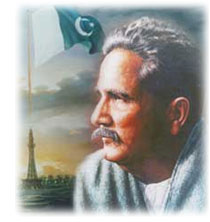
Allama Muhammad Iqbal

Allama Muhammad Iqbal
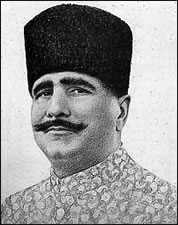
Allama Muhammad Iqbal

Allama Muhammad Iqbal

Allama Mohammad Iqbal - Sitara e Mashriq - Sahar Urdu Tv September 13 2010 Tehran Iran 1/2
Allama Mohammad Iqbal - Sitara e Mashriq - Sahar Urdu Tv September 13 2010 Tehran Iran 2/2
Quaid e Azam Muhammad Ali Jinnah
Quaid e Azam Muhammad Ali Jinnah [1876-1948]
Pakistan, one of the largest Muslim states in the world, is a living and exemplary monument of Quaid-i-Azam Muhammad Ali Jinnah. With his untiring efforts, indomitable will, and dauntless courage, he united the Indian Muslims under the banner of the Muslim League and carved out a homeland for them, despite stiff opposition from the Hindu Congress and the British Government.
Muhammad Ali Jinnah was born in Karachi on December 25, 1876. His father Jinnah Poonja was an Ismaili Khoja of Kathiawar, a prosperous business community. Muhammad Ali received his early education at the Sindh Madrasa and later at the Mission School, Karachi. He went to England for further studies in 1892 at the age of 16. In 1896, Jinnah qualified for the Bar and was called to the Bar in 1897.
Muhammad Ali Jinnah started his political career in 1906 when he attended the Calcutta session of the All India National Congress in the capacity of Private Secretary to the President of the Congress. In 1910, he was elected to the Imperial Legislative Council. He sponsored the Waqf Validating Bill, which brought him in touch with other Muslim leaders. In March 1913, Jinnah joined the All India Muslim League.
As a member of the Muslim League, Jinnah began to work for Hindu-Muslim unity. In 1917, the annual sessions of both the Congress and the League were held at Lucknow. The League session was presided over by Muhammad Ali Jinnah. It marked the culmination of his efforts towards Hindu-Muslim unity. Here, both the League and the Congress adopted a scheme of reforms known as the Lucknow Pact.
On April 19, 1918, Jinnah married Rutanbai. Their daughter, Dina was born a year later. In 1919, Jinnah resigned from his membership of the Imperial Legislative Council as protest against the "Rowlatt Act".
Until the publication of Nehru Report, Jinnah continued his efforts for Hindu-Muslim unity. The Nehru Report, published in 1928, was severely criticized by all sections of the Muslim community. In December 1928, the National Convention was called to consider the Report. Jinnah proposed some amendments, but they were all rejected. He finally parted ways with the Congress.
In 1929, Jinnah presented his famous Fourteen Points in response to the Nehru Report. When he returned from England, he reorganized the Muslim League. In 1934, he was elected as its permanent president.
The Provincial Assembly elections of 1937 swept the Congress to power in eight provinces. After almost two years of oppressive rule, Muslims under the leadership of Jinnah, celebrated the Day of Deliverance at the end of Congress rule.
The Muslim League held its annual session at Lahore in March 1940. This was presided over by Quaid-i-Azam. The demand for Pakistan was formally put forward here. This goal was realized on August 14, 1947. Quaid-i-Azam Muhammad Ali Jinnah was appointed as its first Governor General.
The establishment of Pakistan brought even greater responsibilities for Jinnah. The refugee problem, the withholding of Pakistani assets by India, and the Kashmir problem were a real test for the Quaid.
However, his indomitable will prevailed. He worked out a sound economic policy, established an independent currency and the State Bank for Pakistan. He chose Karachi as the federal capital.
However, he did not live long to witness the progress of the state that he had founded. On September 11, 1948, he died after a protracted illness at Karachi. He was buried in Karachi that witnessed the entire nation mourning over an irreparable loss.


Pakistan, one of the largest Muslim states in the world, is a living and exemplary monument of Quaid-i-Azam Muhammad Ali Jinnah. With his untiring efforts, indomitable will, and dauntless courage, he united the Indian Muslims under the banner of the Muslim League and carved out a homeland for them, despite stiff opposition from the Hindu Congress and the British Government.
Muhammad Ali Jinnah was born in Karachi on December 25, 1876. His father Jinnah Poonja was an Ismaili Khoja of Kathiawar, a prosperous business community. Muhammad Ali received his early education at the Sindh Madrasa and later at the Mission School, Karachi. He went to England for further studies in 1892 at the age of 16. In 1896, Jinnah qualified for the Bar and was called to the Bar in 1897.
Muhammad Ali Jinnah started his political career in 1906 when he attended the Calcutta session of the All India National Congress in the capacity of Private Secretary to the President of the Congress. In 1910, he was elected to the Imperial Legislative Council. He sponsored the Waqf Validating Bill, which brought him in touch with other Muslim leaders. In March 1913, Jinnah joined the All India Muslim League.
As a member of the Muslim League, Jinnah began to work for Hindu-Muslim unity. In 1917, the annual sessions of both the Congress and the League were held at Lucknow. The League session was presided over by Muhammad Ali Jinnah. It marked the culmination of his efforts towards Hindu-Muslim unity. Here, both the League and the Congress adopted a scheme of reforms known as the Lucknow Pact.
On April 19, 1918, Jinnah married Rutanbai. Their daughter, Dina was born a year later. In 1919, Jinnah resigned from his membership of the Imperial Legislative Council as protest against the "Rowlatt Act".
Until the publication of Nehru Report, Jinnah continued his efforts for Hindu-Muslim unity. The Nehru Report, published in 1928, was severely criticized by all sections of the Muslim community. In December 1928, the National Convention was called to consider the Report. Jinnah proposed some amendments, but they were all rejected. He finally parted ways with the Congress.
In 1929, Jinnah presented his famous Fourteen Points in response to the Nehru Report. When he returned from England, he reorganized the Muslim League. In 1934, he was elected as its permanent president.
The Provincial Assembly elections of 1937 swept the Congress to power in eight provinces. After almost two years of oppressive rule, Muslims under the leadership of Jinnah, celebrated the Day of Deliverance at the end of Congress rule.
The Muslim League held its annual session at Lahore in March 1940. This was presided over by Quaid-i-Azam. The demand for Pakistan was formally put forward here. This goal was realized on August 14, 1947. Quaid-i-Azam Muhammad Ali Jinnah was appointed as its first Governor General.
The establishment of Pakistan brought even greater responsibilities for Jinnah. The refugee problem, the withholding of Pakistani assets by India, and the Kashmir problem were a real test for the Quaid.
However, his indomitable will prevailed. He worked out a sound economic policy, established an independent currency and the State Bank for Pakistan. He chose Karachi as the federal capital.
However, he did not live long to witness the progress of the state that he had founded. On September 11, 1948, he died after a protracted illness at Karachi. He was buried in Karachi that witnessed the entire nation mourning over an irreparable loss.
Quaid e Azam Muhammad Ali Jinnah
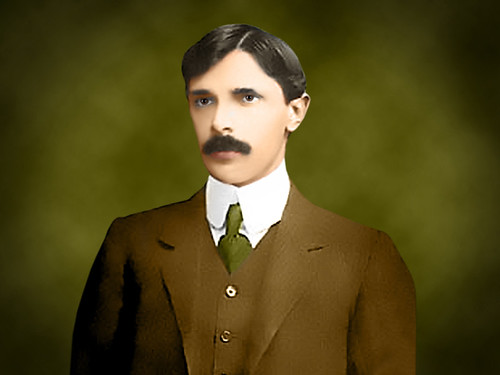
Quaid e Azam Muhammad Ali Jinnah

Quaid e Azam Muhammad Ali Jinnah

Quaid e Azam Muhammad Ali Jinnah
Jinnah - A Documentary
Quaid-e-Azam Mohammad Ali Jinnah
Subscribe to:
Posts (Atom)